 Jewelry Identifier
Inherited Jewelry: How to Figure Out What It's Worth
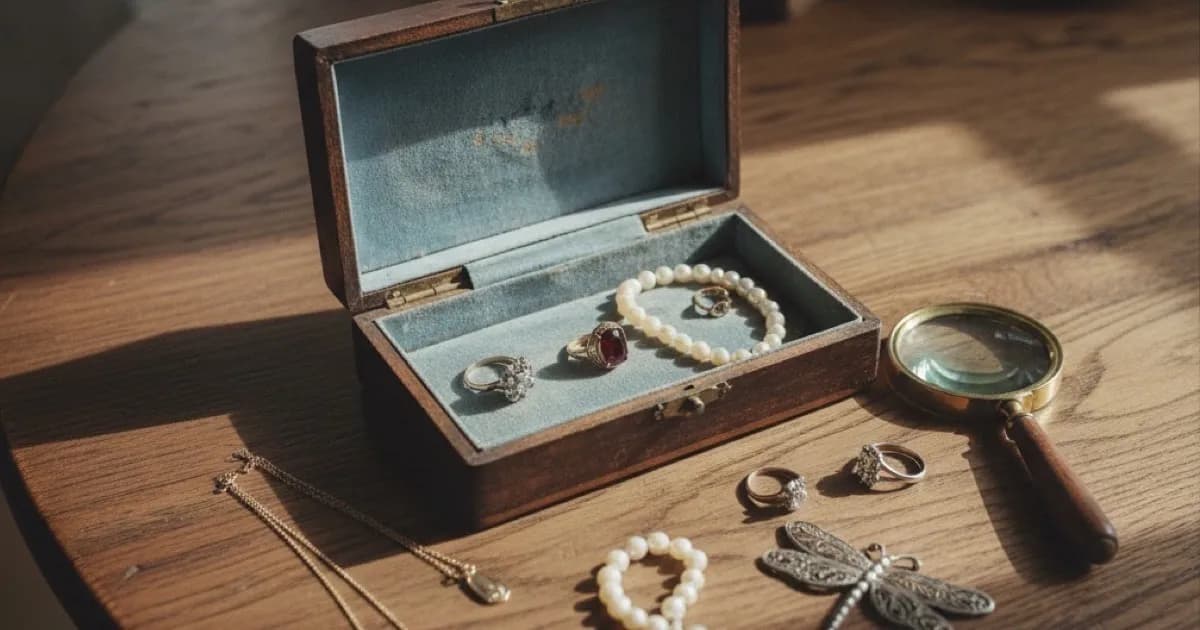
Somebody leaves you a box of jewelry. Maybe a parent, grandparent, or aunt. You open it and find rings, necklaces, brooches, and pieces you can't even name. Some look expensive. Others might be costume. And you have no idea what any of it is worth.
Figuring out inherited jewelry value is confusing because the pieces come without receipts, certificates, or context. The gold bracelet your grandmother wore every day might be worth $2,000 or $200 — and you can't tell by looking. This guide walks you through how to identify, assess, and value inherited jewelry step by step.
Why Inherited Jewelry Value Is Hard to Pin Down
The biggest challenge with inherited pieces is missing information. You rarely get documentation. No original receipts, no appraisal certificates, no purchase history. You're starting from zero.
Age complicates things further. A ring from the 1940s could be valuable because of its vintage status, or it could be a department store piece that wasn't worth much when it was new. Old doesn't automatically mean valuable.
Sentimental value and market value are completely different numbers. Your grandmother's favorite brooch might mean everything to the family and be worth $30 at resale. A heavy gold chain nobody remembers wearing might be worth $1,500 in melt value alone.
The market for inherited jewelry depends on these factors:
- Metal content — Gold, silver, and platinum have inherent value based on weight and purity
- Gemstone quality — Real diamonds, rubies, sapphires, and emeralds add significant value. Simulants and synthetics add much less
- Craftsmanship and brand — Tiffany, Cartier, and other luxury brands command premiums. Handcrafted artisan pieces can too
- Condition — Missing stones, broken clasps, and heavy wear reduce value. Pieces in original condition are worth more
- Provenance — Documentation, original boxes, or connection to notable people increases value
How to Identify What You've Inherited
Before you can value anything, you need to know what you're looking at. Start with these checks.
Check for Stamps and Hallmarks
Flip every piece over and examine it with a magnifying glass. Look inside ring bands, on clasp faces, on the backs of pendants, and along bracelet links.
Common stamps tell you the metal:
- 10K, 14K, 18K, 24K — Gold, with increasing purity
- 925 — Sterling silver
- 950 — Platinum
- GP, GF, GE — Gold plated, gold filled, gold electroplated (not solid gold)
- STER, SS — Sterling silver
- PAL, PLAT — Platinum
Some stamps indicate the maker. Cartier, Tiffany & Co., and other luxury houses stamp their names directly. Older pieces may have symbols or codes that require research. Our stamps and hallmarks guide covers how to decode these marks in detail.
Identify the Gemstones
Determine whether stones are natural, synthetic, or glass. Real gemstones are usually set in precious metals. A diamond in a 14K gold setting is likely real. A "diamond" in a base metal setting is probably glass or cubic zirconia.
Look for:
- Inclusions in the stone — Natural gems have tiny imperfections visible under magnification. Perfect clarity suggests synthetic or glass
- Color saturation — Overly vivid, uniform color can indicate a synthetic stone
- Setting quality — Prong settings for individual stones suggest the jeweler valued the gem enough to mount it securely
Our gemstone identification guide goes deeper into specific tests for diamonds, rubies, sapphires, and emeralds.
Note Maker's Marks
Some inherited jewelry carries maker's marks — tiny stamps or engravings that identify the manufacturer, designer, or workshop. These marks can dramatically affect value. A sterling silver pendant marked "Georg Jensen" is worth many times more than an unmarked one with a similar design.
Maker's marks worth researching:
- Tiffany & Co. — Consistently high resale value
- Cartier — Premium pricing, especially for vintage pieces
- David Yurman — Strong secondary market
- Georg Jensen — Sought after by collectors
- Mexican silver marks (eagle stamp) — Vintage Mexican silver pieces have an active collector market
Types of Inherited Jewelry and Their Typical Worth
Here's what common inherited pieces tend to be worth at resale. These are general ranges — your specific piece may fall outside them.
Gold Jewelry
Gold value has a floor: its melt value. Weigh the piece, factor in the karat purity, and calculate based on the current gold spot price.
- A 14K gold chain weighing 20 grams is worth roughly $750-850 in gold alone (at ~$2,300/oz spot)
- A 10K gold ring weighing 5 grams is worth about $140-160 in melt value
- Pieces with gemstones, brand names, or artistic merit sell above melt
Our gold jewelry guide covers gold testing and valuation in detail.
Diamond Rings
Inherited diamond engagement rings are among the most common and most variable pieces. Value depends heavily on the 4Cs (carat, cut, color, clarity).
- 0.25-0.50 carat solitaire in 14K gold: $200-800
- 0.50-1.0 carat solitaire in 14K-18K gold: $800-5,000
- 1.0+ carat with good cut and clarity: $3,000-20,000+
Without a GIA or AGS certificate, buyers discount heavily. If you suspect a diamond is valuable, a professional grading report costs $50-150 and can multiply the selling price. See our diamond ring value guide for a detailed breakdown.
Pearl Strands
Pearl values range widely. Freshwater cultured pearl strands start around $50. South Sea pearl strands can exceed $50,000. The pearl identification guide explains how to test whether pearls are genuine and identify the type.
Sterling Silver
Silver jewelry has modest metal value (silver trades around $25-30/oz compared to gold's $2,300+). But certain silver pieces carry collector premiums:
- Native American turquoise jewelry: $100-2,000+ depending on artist and age
- Georg Jensen designs: $200-5,000+ for desirable patterns
- Mexican silver from Taxco: $50-500 for vintage pieces
- Art Deco silver: $100-1,000 for quality examples
Our guide on how to tell if silver is real covers testing methods.
Costume Jewelry Surprises
Not everything without precious metals is worthless. Some costume jewelry is worth real money. Signed pieces from Miriam Haskell, Eisenberg, Weiss, and Schreiner regularly sell for $100-500+. Bakelite jewelry from the 1930s-40s commands $50-300 per piece.
Professional Appraisal vs Quick Identification
You don't need a professional appraisal for every piece. Here's when each approach makes sense.
Get a professional appraisal ($50-150 per piece) when:
- A piece appears to contain a diamond over 0.5 carats
- You're splitting an estate and need fair market values for division
- You need documentation for insurance coverage
- A piece may be from a luxury brand or notable designer
A quick identification is enough when:
- You're sorting through a large collection and need to separate valuable from costume
- You want a rough sense of what you're dealing with before investing in appraisals
- The pieces appear to be modest everyday jewelry
- You're deciding which pieces to keep vs sell
For large inherited collections, the practical approach is to do a quick assessment of everything first, then invest in professional appraisals only for pieces that appear valuable.
How Jewelry Identifier Helps With Inherited Pieces
When you inherit a box of jewelry, sorting through it piece by piece with a jeweler costs time and money. Jewelry Identifier gives you a fast starting point from your phone.
Snap a photo of each piece, and the AI identifies the metal type, reads any stamps or hallmarks, identifies gemstones, and provides an estimated value. This helps you quickly separate the gold from the costume, the real diamonds from the glass, and the valuable vintage from the everyday pieces.
The app reads stamps and hallmarks that are hard to decipher with the naked eye — especially on older pieces where marks have worn down. It also identifies maker's marks that could signal a piece worth professional appraisal.
Two free identifications per day let you work through a collection gradually.
Frequently Asked Questions
Do I need a formal appraisal for insurance?
Yes. Insurance companies require a certified appraisal document with detailed descriptions, photographs, and replacement values. AI-based estimates aren't accepted for insurance purposes. Look for an appraiser certified by GIA, ASA, or AAA. Budget $50-150 per piece for insurance appraisals.
Should I clean inherited jewelry before getting it appraised?
Gently clean pieces with warm water and mild soap to remove surface dirt — this helps the appraiser see details clearly. Don't use harsh chemicals, ultrasonic cleaners, or abrasive materials, especially on pearls, opals, or emeralds. These stones are soft and can be damaged by aggressive cleaning.
How do I split inherited jewelry fairly among family?
Have everything appraised first so you're working with actual numbers. Then divide by value, not by piece count. Some families use a draft system where each person takes turns choosing, using appraised values to keep selections roughly equal. A written agreement prevents disputes later.
Is inherited jewelry taxable?
In the United States, inherited jewelry isn't taxed as income. But if you sell it for more than the fair market value at the time of inheritance (the "stepped-up basis"), the profit is subject to capital gains tax. Keep appraisals to document the value at the time you received the pieces.
Not sure what that ring, necklace, or brooch from your loved one is actually worth? Jewelry Identifier reads the stamps, identifies the stones and metals, and gives you an estimated value in seconds — all from a photo. Try it free with two daily identifications, and know what you have before visiting a jeweler.