 Jewelry Identifier
How to Tell if Pearls Are Real: 6 Tests That Actually Work
Real pearls range from $50 to $50,000+ per strand. Fake pearls cost $5-20. They can look remarkably similar, and the "pearl" necklace in your jewelry box might be either one. Knowing the difference matters before you sell, insure, or give away what could be a valuable piece.
Here are six tests that show you how to tell if pearls are real at home, plus what to know about pearl types and what they're worth.
Real Pearls vs Fake Pearls: A Quick Primer
Real pearls come in two categories. Natural pearls form without any human intervention — an irritant enters the mollusk, and the animal coats it in nacre over years. These are extremely rare and expensive. Cultured pearls are grown with human assistance: a technician inserts a nucleus into the mollusk to start the nacre-building process. Cultured pearls are real pearls. They're just farmed instead of found.
Manufacturers produce fake (imitation) pearls from glass, plastic, or shell beads coated with a pearlescent paint or fish-scale lacquer to mimic real nacre. Some high-end imitations like Majorica pearls are convincing, but they're still manufactured products. Our gemstone identification guide covers similar real-vs-fake testing for diamonds, rubies, and sapphires.
Test 1: The Tooth Test
This is the classic and still one of the most reliable quick tests.
Gently rub the pearl along the biting edge of your front teeth. Real pearls feel slightly gritty or sandy. Fake pearls feel smooth, almost glassy.
The grittiness comes from the crystalline structure of nacre — real pearl surfaces are made of thousands of microscopic aragonite platelets stacked in overlapping layers. Fake pearls have a smooth, uniform coating that lacks this texture.
Use light pressure. You're feeling for texture, not trying to scratch the pearl. This test works on both natural and cultured pearls — both have real nacre, so both feel gritty.
Test 2: Surface Inspection
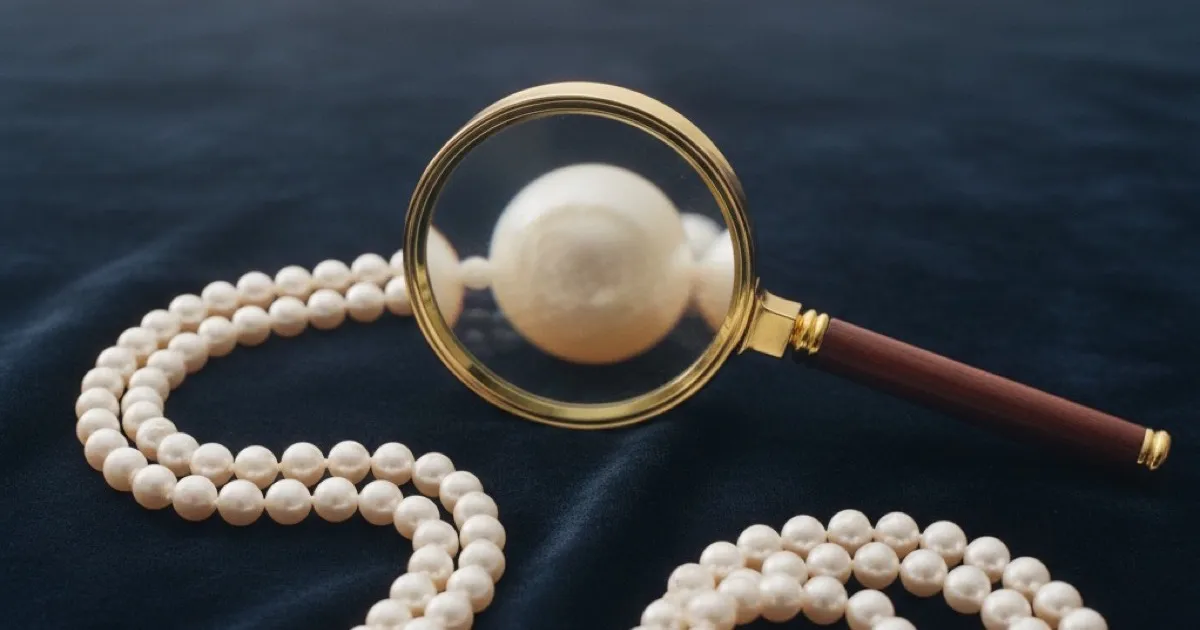
Examine the pearls under good light with a magnifying glass or your phone's camera zoomed in.
Real pearls show:
- Tiny surface irregularities — small ridges, bumps, or texture variations
- Subtle color variations between individual pearls in a strand
- A deep, complex luster that seems to glow from within (called "orient")
- Slight size and shape differences from pearl to pearl
Fake pearls show:
- Perfectly smooth, uniform surfaces
- Identical size and shape across every pearl in the strand
- A flat, paint-like shine that reflects from the surface only
- Sometimes visible brush strokes or coating imperfections under magnification
Perfect uniformity is the giveaway. Nature doesn't produce identical objects. If every pearl on a strand looks exactly the same, they're manufactured.
Test 3: The Drill Hole Test
Look at the holes where pearls are strung. This is one of the most telling indicators.
On real pearls, the drill holes are clean and sharp-edged. You can often see the nacre layers at the edge of the hole — concentric rings, like tree growth rings in miniature.
On fake pearls, the drill holes often show chipping, flaking, or peeling where the surface coating has come away from the bead underneath. You might see the glass or plastic core material exposed at the edges. Over time, the coating around the holes wears thin from the string rubbing against it.
A magnifying glass makes this test much easier. The difference is usually obvious once you know what to look for.
Test 4: The Weight Test
Real pearls are heavier than most imitations. Pick up a strand and bounce it gently in your hand. Real pearl strands have a satisfying, solid weight to them. Glass-bead fakes can also feel heavy, but plastic imitation pearls feel noticeably light — almost hollow.
This test works best as a comparison. If you have a strand you know is real, hold it in one hand and the questionable strand in the other. The weight difference between real pearls and plastic fakes is immediately obvious.
High-end glass imitations (like Majorica) are weighted to feel similar to real pearls, so this test isn't definitive on its own. Use it alongside the tooth and surface tests.
Test 5: The Temperature Test
Pick up the pearls and notice how they feel against your skin. Real pearls feel cool to the touch initially, then warm up gradually as they absorb body heat. They adapt to your temperature over a minute or two.
Plastic imitation pearls feel closer to room temperature immediately — neither distinctly cool nor warm. Glass fakes feel cool initially (similar to real pearls) but don't warm up as naturally.
This test is subtle and works best if you handle the pearls before they've been sitting in a warm display case or pocket. Test them after they've been resting at room temperature for a while.
Test 6: The Rub Test
Gently rub two pearls against each other. Real pearls produce a slight resistance — a mild friction with a faintly powdery feeling. You might notice a tiny amount of pearl powder (nacre dust) on your fingers afterward.
Fake pearls slide against each other smoothly, almost like rubbing two glass beads together. There's no resistance and no powdery residue.
After rubbing real pearls together, the surface isn't damaged — any minor scuff buffs out because nacre is self-healing to a degree. Fake pearls may show visible scratches where the coating scraped off during rubbing.
What Real Pearls Are Worth
Pearl values vary enormously based on type, size, shape, luster, and surface quality.
- Freshwater cultured pearls — $50-500 per strand. These are the most common and affordable real pearls. Often slightly irregular in shape.
- Akoya cultured pearls — $200-2,000+ per strand. Classic round white pearls from Japan and China. The standard for "fine pearl jewelry."
- Tahitian pearls — $500-25,000+ per strand. Dark, exotic colors (black, green, peacock). Larger than Akoya.
- South Sea pearls — $1,000-50,000+ per strand. The largest cultured pearls (10-16mm+). White or golden. Top of the market.
- Natural pearls — $10,000-$1M+. Extremely rare. Most are vintage or antique pieces. Almost never found in stores.
Size matters significantly. Pearl value increases exponentially with diameter. An 8mm Akoya pearl might cost twice as much as a 7mm from the same strand, and a 9mm costs even more. For a broader look at what drives jewelry pricing, see our guide on how to determine jewelry value.
The Setting Tells a Story Too
The metal holding the pearls often reveals as much as the pearls themselves. Genuine pearl jewelry is typically set in gold (10K-18K), sterling silver, or platinum. If the clasp or setting is stamped with a precious metal mark, that's a strong indicator the pearls are real. Jewelers don't mount $5 imitation pearls in 14K gold settings.
Check the clasp, bail, or earring posts for stamps like 14K, 925, or 750. No stamp or a stamp reading "GP" (gold plated) suggests the pearls might be imitation too. The investment in the setting generally matches the investment in the stones. You can learn more about reading those marks in our stamps and hallmarks guide.
Identifying Pearls From a Photo
If you want a quick assessment before running physical tests, Jewelry Identifier can analyze photos of pearl jewelry. The AI identifies whether pearls appear to be genuine or imitation, identifies the metal in the setting, and provides an estimated value for the piece.
Take photos in natural light, include close-ups of the pearl surface and any clasps (which may have stamps indicating the metal quality — a hint about whether the setting matches real-pearl pricing). Two free identifications per day.
Frequently Asked Questions
Are cultured pearls real?
Yes. Cultured pearls are grown inside real mollusks using the same nacre-building process as natural pearls. The only difference is that a technician starts the process by inserting a nucleus. Cultured pearls are genuine pearls, not imitations.
Can fake pearls pass the tooth test?
High-quality imitations with textured coatings can feel slightly rough. But the grittiness of real nacre has a distinctive fine, sandy quality that's different from the rough texture of a coated bead. If you've felt real pearls against your teeth, the difference becomes recognizable.
Do real pearls turn yellow?
Over decades, real pearls can develop a yellowish tinge from dehydration and chemical changes in the nacre. Proper storage (cool, slightly humid environment) slows this. Pearls that yellow aren't fake — they're just aged. Regular wearing actually helps keep pearls healthy because your skin's natural oils moisturize the nacre.
How can I tell freshwater from saltwater pearls?
Freshwater pearls tend to be slightly less round, with a more textured surface and a softer luster. Saltwater pearls (Akoya, Tahitian, South Sea) are typically rounder, smoother, and have a sharper, more mirror-like luster. An X-ray is the only definitive way to distinguish them — the internal structures differ — but luster and shape differences are usually enough for a practical assessment.
The tooth test and surface inspection together catch the vast majority of fakes. If both pass, you likely have real pearls. For valuable-looking strands, a jeweler or gemologist with a refractometer can give you a definitive answer and tell you the specific pearl type and quality grade. Jewelry Identifier gives you a fast first read from your phone — useful when deciding whether a piece is worth the trip to a professional.