 Jewelry Identifier
Types of Gold Chains: A Guide to Every Style
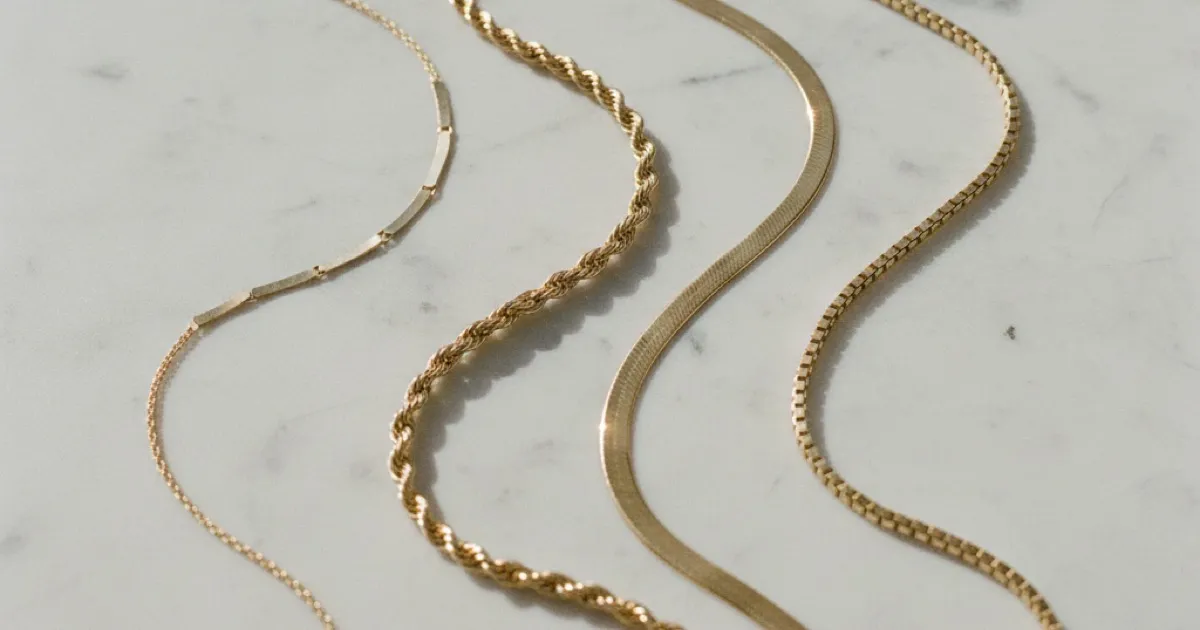
Gold chains come in dozens of styles, and the differences aren't just cosmetic. The type of chain affects durability, comfort, how it catches light, and — critically — its value. A hollow rope chain and a solid Cuban link at the same weight can differ by thousands of dollars. Knowing the types of gold chains helps whether you're buying, selling, identifying an inherited piece, or just figuring out what's hanging around your neck.
This guide covers the most common chain styles, how to identify each one, what affects their value, and which styles hold up best over time.
Link Chains
Link chains are the most traditional category. Each style uses a different link shape and connection method, which changes the look, strength, and flexibility of the chain.
Cable Chain
The simplest chain design: identical oval or round links connected in a uniform pattern. Each link sits perpendicular to the next, creating a classic, understated look.
- Best for: everyday wear, pendant chains, minimalist jewelry
- Durability: moderate — individual links can bend or break under stress, but repairs are straightforward
- Value range: $100-$800 for 14K gold, depending on thickness and length
- How to identify: look for uniform oval links alternating in direction, with visible gaps between links
Figaro Chain
An Italian design that alternates between short round links and one longer oval link — typically in a 3:1 or 2:1 pattern. The repeating pattern gives it a distinctive rhythm that's easy to spot.
- Best for: men's chains, standalone necklaces (the pattern is interesting enough to wear without a pendant)
- Durability: good — the varied link sizes distribute stress well
- Value range: $200-$1,500 for 14K gold
- How to identify: count the pattern — if you see 2-3 small links followed by one longer link, repeating, it's a Figaro
Curb Chain (Cuban Link)
Flat, interlocking links that lie flush against each other when the chain is laid flat. Cuban links are the heavier, wider version of the standard curb chain — the same construction, just scaled up.
- Best for: statement pieces, men's jewelry, hip-hop and streetwear styles
- Durability: excellent — the flat interlocking design distributes weight evenly and resists kinking
- Value range: $300-$10,000+ for 14K gold. Heavy Cuban links in 18K or 24K gold can reach five figures
- How to identify: lay the chain flat — if the links sit flush in a uniform row with no twisting, it's a curb/Cuban. Wider and heavier versions are typically called Cuban links
Rolo Chain
Round links of uniform size connected in an alternating pattern, similar to cable but with rounder, thicker links. Sometimes called "belcher chain" in the UK.
- Best for: charm bracelets, pendant necklaces, casual everyday wear
- Durability: good — the thick round links are sturdy
- Value range: $150-$1,000 for 14K gold
- How to identify: perfectly round links (not oval) alternating direction, with a chunky, open look
Woven and Braided Chains
These chains use links woven together in complex patterns, creating a more textured, sophisticated appearance.
Rope Chain
Multiple link segments twisted together in a spiral pattern that resembles an actual rope. One of the most popular chain styles worldwide.
- Best for: both casual and dressy wear, works well with or without pendants
- Durability: very good when solid — the twisted structure is inherently strong. Hollow rope chains are much weaker and prone to denting
- Value range: $200-$3,000+ for 14K solid gold. Hollow versions cost 40-60% less but don't hold up
- How to identify: look for the spiral twist pattern. Roll it between your fingers — a rope chain has a textured, ridged feel
Franco Chain
A V-shaped link pattern where links interlock in four directions, creating a squared-off chain with a smooth, almost mesh-like appearance. Developed in Italy.
- Best for: men's jewelry, heavier pendants (the strong construction handles weight well)
- Durability: excellent — the four-directional interlocking makes it one of the strongest chain types
- Value range: $400-$3,000+ for 14K gold
- How to identify: look at the chain from the end — it should appear square or V-shaped in cross-section, with links interlocking in a tight pattern
Wheat Chain (Spiga)
Oval links braided together in a figure-eight pattern, creating a smooth, rounded chain that looks like a stalk of wheat. The Italian name "spiga" literally means "ear of wheat."
- Best for: women's necklaces, elegant everyday wear, pendant chains
- Durability: very good — the braided structure is strong and flexible
- Value range: $200-$1,500 for 14K gold
- How to identify: a smooth, slightly twisted appearance with no visible individual links — the braiding creates a seamless look
Flat and Specialty Chains
Herringbone Chain
Flat, V-shaped links laid side by side to create a smooth, ribbon-like chain. Named for its resemblance to the herringbone fabric pattern.
- Best for: women's necklaces, layering, formal wear
- Durability: poor to moderate — herringbone chains kink easily and the flat links can bend permanently. Handle with care
- Value range: $300-$2,000 for 14K gold
- How to identify: completely flat and smooth on both sides, with a slight V-shaped texture visible up close. Extremely flexible — drapes like fabric
Box Chain
Square links connected at their corners, creating a smooth, geometric chain with a distinctive squared profile.
- Best for: pendant chains (the sturdy construction supports heavier pendants), dog tags, minimalist styles
- Durability: moderate to good — stronger than cable chains, but individual links can break under sudden stress
- Value range: $100-$800 for 14K gold
- How to identify: look at the chain from the end — the links should appear square, not round or oval
Snake Chain
Round or square links fitted tightly together to form a smooth, flexible tube that resembles snakeskin. No visible individual links when the chain is intact.
- Best for: sleek, modern jewelry, Pandora-style charm bracelets, formal necklaces
- Durability: poor — snake chains kink easily, and kinks are nearly impossible to repair. The tightly packed structure means one damaged link affects the whole chain
- Value range: $200-$1,200 for 14K gold
- How to identify: completely smooth with no visible links. Feels like a flexible metal tube. Bends in a smooth curve, not in segments
What Affects a Gold Chain's Value
The chain style is only part of the equation. These factors determine what a gold chain is actually worth:
Karat (purity). 24K is pure gold (99.9%), 18K is 75% gold, 14K is 58.3%, and 10K is 41.7%. Higher karat means more gold content and higher melt value — but also softer metal that's more prone to damage. 14K is the most common for chain jewelry in the US because it balances durability with gold content.
Solid vs. hollow. This is the biggest value differentiator most people miss. A solid 14K rope chain might weigh 25 grams, while a hollow version of the same dimensions weighs 8 grams. They look identical when worn, but the solid chain contains three times the gold. Always ask — or test — whether a chain is solid or hollow before buying or selling. Our gold jewelry guide covers testing methods in detail.
Weight. Gold chains are ultimately valued by weight. Heavier chains contain more gold. When selling, dealers price chains based on weight and karat, not style — a 30-gram 14K Cuban link and a 30-gram 14K rope chain have the same melt value.
Craftsmanship. Machine-made chains are less expensive than hand-made ones. Italian chains command a premium for their reputation in craftsmanship. Branded chains (Tiffany, Cartier, etc.) carry brand premiums of 2-5x over their gold content value.
Clasp type. Lobster clasps are the most common and reliable. Spring rings are cheaper but weaker. Barrel clasps and toggle clasps are decorative but less secure. The clasp also contains gold, so it contributes to total weight and value.
If you're trying to figure out what your gold chain is worth, see our guide on how much is my necklace worth for a step-by-step valuation approach.
How to Tell if a Gold Chain Is Real
Before worrying about chain type, confirm you're looking at actual gold. Gold-plated, gold-filled, and gold-vermeil chains look similar to solid gold but are worth a fraction of the price.
Quick checks:
- Look for stamps: 10K, 14K, 18K, 24K, 375, 585, 750, or 999 stamped on the clasp or a tag near it
- Magnet test: gold is not magnetic. If the chain sticks to a strong magnet, it's not solid gold (though passing the magnet test doesn't confirm it's gold — stainless steel also passes)
- Weight: gold is dense. A real gold chain feels heavier than it looks. If a thick chain feels surprisingly light, it may be hollow or plated
- Discoloration: green or black marks on skin suggest a base metal under plating
For a deeper dive into gold authentication, our guide on how to tell if gold is real covers 8 tests you can do at home.
How Jewelry Identifier Helps
Identifying chain types, reading tiny karat stamps, and distinguishing solid from hollow construction can be tricky — especially with inherited or secondhand pieces where you don't have the original documentation.
Jewelry Identifier lets you photograph your chain and get an AI-powered identification that covers the chain style, metal type, and an estimated value. The app reads stamps and hallmarks from photos, so you can check karat markings without squinting through a loupe.
You get 2 free identifications per day. Download Jewelry Identifier on iOS or Android to identify your gold chain in seconds.
Frequently Asked Questions
What is the strongest type of gold chain?
Curb chains (Cuban links) and Franco chains are the strongest due to their interlocking flat-link design. Rope chains are also very durable when solid. Avoid herringbone and snake chains if you need strength — they kink easily and are difficult to repair.
What type of gold chain is best for everyday wear?
Cable, curb, and rope chains handle daily wear best. They resist kinking, tolerate movement, and are relatively easy to repair if damaged. Herringbone and snake chains are better reserved for occasional wear since they're more fragile.
Are hollow gold chains worth buying?
Hollow chains cost 40-60% less than solid chains of the same dimensions, but they're significantly less durable. They dent, kink, and break more easily, and repairs are harder. If budget is the priority, a thinner solid chain is usually a better long-term investment than a thick hollow one.
How do I know what karat my gold chain is?
Check the clasp or a small tag near the clasp for stamps: 10K, 14K, 18K, 24K (US system) or 375, 585, 750, 999 (European millesimal system). If there's no stamp, a jeweler can test it with an acid test kit or electronic gold tester.
Which gold chain style holds its value best?
From a resale perspective, the chain style matters less than the gold content. Solid chains in 14K or 18K gold hold value based on weight. For brand-name chains (Cartier, Tiffany), the style and brand premium can add significant resale value beyond melt price.