 Jewelry Identifier
How Much Is My Necklace Worth? A Practical Pricing Guide
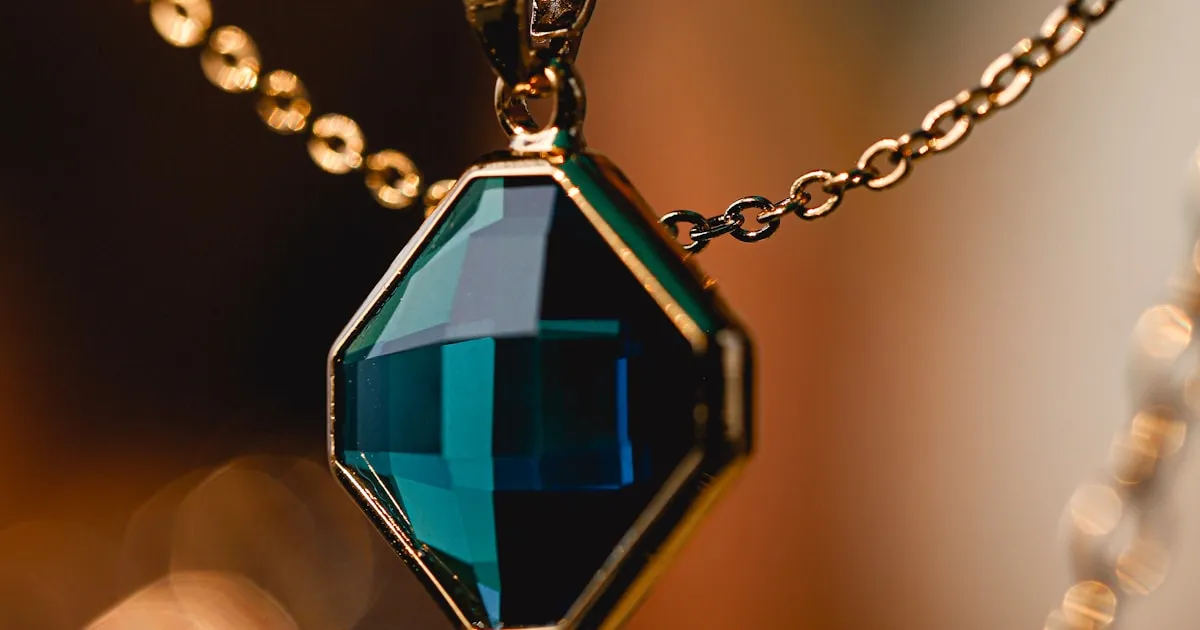
You're holding a necklace and wondering what it's worth. Maybe it's a gold chain from a relative. Maybe it's a pearl strand you found at an estate sale. Maybe it's a pendant you've worn for years and never thought about selling until now.
Necklace values range from pocket change to six figures. The difference comes down to what it's made of, who made it, and what condition it's in.
Step 1: Identify the Metal
Flip the necklace over and look for a stamp on the clasp or near the clasp. This tells you what you're working with.
Gold stamps and what they mean:
- 999 or 24K — Pure gold (rare in necklaces, common in Asian jewelry)
- 750 or 18K — 75% gold, the standard for fine jewelry worldwide
- 585 or 14K — 58.5% gold, the most common in American jewelry
- 417 or 10K — 41.7% gold, minimum legal standard in the US
- 925 — Sterling silver
- GF or 1/20 — Gold-filled (a thick layer of gold over base metal, worth less than solid gold)
- GP or GEP — Gold-plated (minimal gold, worth almost nothing for the metal alone)
No stamp? That usually means costume jewelry or very old pieces made before stamping was standard. A magnet test helps: if it sticks, the base metal isn't gold, silver, or platinum.
Step 2: Weigh It
Metal value is calculated by weight. A kitchen scale works for rough estimates, though a jeweler's scale is more precise.
A typical 18-inch 14K gold chain weighs 8-15 grams depending on thickness. At current gold prices around $60/gram for pure gold, a 10-gram 14K chain has about $350 in gold content (10 grams × $60 × 0.585 purity).
That's melt value. A chain in good condition from a recognized maker sells for more than its melt value. A damaged chain with a broken clasp might sell for exactly melt value.
Step 3: Evaluate Stones and Pendants
If your necklace has a pendant with stones, the stones could be worth more than the chain. Or they could be worth nothing. Identification matters.
Diamonds: Even small accent diamonds add value. A pendant with a 0.5-carat center diamond in good quality might add $500-2,000 to the necklace's value depending on the 4Cs. Check for GIA inscriptions on the stone's edge.
Pearls: Natural pearls are rare and valuable. Cultured pearls (the vast majority) vary enormously. A strand of freshwater cultured pearls might be worth $50-300. Akoya pearls run $200-2,000. South Sea and Tahitian pearls can reach $5,000-50,000 for fine strands. Size, luster, surface quality, and matching all matter.
Colored stones: Ruby, sapphire, and emerald pendants need careful evaluation. The same stone can be worth $50 or $50,000 depending on quality and origin. Without lab certification, assume the lower end.
Costume stones: Glass, rhinestones, and synthetic materials add minimal value for the stones themselves. But vintage costume necklaces from desirable makers can be valuable as complete pieces.
Step 4: Check the Maker
A maker's mark changes everything. Look near the clasp for engraved names, logos, or symbols.
Necklace brands that command premiums:
- Tiffany & Co. — The Tiffany blue box adds 40-100% to metal value
- Cartier — Especially the Juste un Clou and Love collections
- Van Cleef & Arpels — Alhambra necklaces hold value exceptionally well
- Bulgari — B.zero1 and Serpenti lines resell strongly
- David Yurman — Cable collection has active resale market
For vintage costume necklaces, look for:
- Miriam Haskell — Unsigned before 1950, signed after
- Trifari — Crown Trifari pieces from the 1940s-60s are most valuable
- Eisenberg — Known for high-quality rhinestones
- Chanel — Vintage costume pieces fetch hundreds to thousands
Step 5: Assess Condition
Condition affects necklace value more than most jewelry types because necklaces take more daily abuse. Check for:
- Clasp function — Does it open and close securely?
- Chain integrity — Any kinked, stretched, or weakened links?
- Pearl stringing — Are pearls knotted individually? Is the silk stretched or discolored?
- Stone security — Are all stones present and firmly set?
- Surface condition — Deep scratches and dents versus normal wear
Pearl necklaces need restringing every few years. If the silk thread looks gray or stretched, that's a repair cost (typically $50-150) that factors into your valuation.
Common Necklace Types and Their Typical Values
Plain gold chain (14K, no pendant): Melt value to 1.5× melt value. For a mid-weight chain, that's typically $200-600.
Diamond pendant necklace: Highly variable. A 0.25ct diamond on a 14K chain might be worth $300-600 total. A 1ct diamond on a platinum chain could be $3,000-8,000.
Pearl strand: Freshwater cultured strands run $30-300. Fine Akoya strands run $500-5,000. South Sea or Tahitian strands start around $1,000 and climb from there.
Designer necklace: Varies by brand and model. A Tiffany Return to Heart tag necklace in silver might be worth $80-150 resale. A Cartier Love necklace in gold runs $2,000-4,000 resale.
Vintage costume necklace: Most are worth $10-50. Signed pieces from collectible makers can reach $200-2,000.
Getting Your Necklace Valued
For a quick first estimate, use an AI jewelry identification app. Take clear photos showing the clasp area (for stamps), any stones, and the overall piece. You'll get a ballpark number in under a minute.
If the initial estimate suggests real value, take it further. Get in-person evaluations from two independent jewelers. For pieces potentially worth over $1,000, a formal written appraisal ($50-150) gives you documentation for insurance or sale.
Don't accept the first offer from a buyer. Gold buyers, pawn shops, and consignment stores all calculate differently. The spread between the lowest and highest offer for the same necklace can be 40-60%. Getting multiple quotes takes an afternoon but can mean hundreds of dollars difference.