 Jewelry Identifier
Types of Jewelry Clasps: A Visual Guide to Every Style
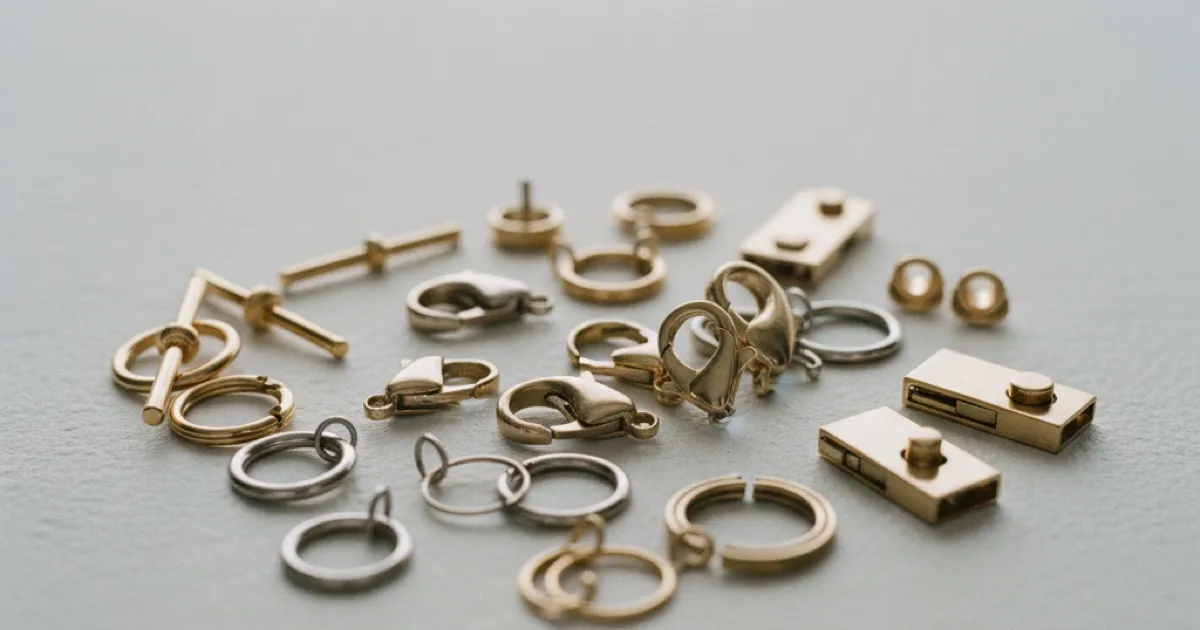
The clasp on a piece of jewelry does more than hold it together. It tells you when the piece was made, how it was manufactured, and sometimes who made it. If you're trying to date a vintage necklace, figure out why a bracelet keeps falling off, or decide whether a piece is worth repairing, the clasp is where you start.
Knowing the different types of jewelry clasps helps you date vintage pieces, troubleshoot why something keeps falling off, and understand what you're looking at when evaluating quality.
Necklace and Chain Clasps
Spring Ring Clasp
The most common clasp on everyday necklaces and chains. A small circular ring with a spring-loaded lever that opens when you pull it back.
- When used: 1900s to present
- Found on: Chains, delicate necklaces, lightweight pendants
- Quality indicator: Common on all quality levels. Fine jewelry uses gold or platinum spring rings; costume jewelry uses plated or base metal
- Durability: Moderate. The spring mechanism wears out over time, especially on pieces worn daily. Average lifespan: 5-15 years of regular use
Spring rings are the hardest clasp to operate one-handed, which is why many people struggle with necklace clasps behind their neck.
Lobster Claw Clasp
A D-shaped clasp with a spring-loaded gate. Larger and more secure than spring rings.
- When used: 1970s to present
- Found on: Chains, bracelets, heavier necklaces
- Quality indicator: Standard on mid-range to fine jewelry. The size and weight of the lobster claw often match the quality of the piece
- Durability: Good. Stronger spring mechanism than spring rings. Lifespan: 10-20+ years
Lobster claws became popular because they're easier to operate than spring rings and more secure. If your necklace has a lobster claw, it was likely made after 1970.
Box Clasp (Tab and Slot)
A flat rectangular clasp where a bent metal tab slides into a box-shaped housing and locks with a click. Often includes a safety catch (a small folding hook).
- When used: 1800s to present
- Found on: Pearl strands, multi-strand necklaces, fine bracelets
- Quality indicator: High. Box clasps require more manufacturing skill. Found on quality pearl necklaces and fine jewelry
- Durability: Excellent when properly made. The mechanism can weaken if bent repeatedly
Box clasps on pearl necklaces are a sign of quality stringing. Cheap pearl strands use barrel clasps or spring rings. Box clasps with safety catches are even better — the folding hook prevents the clasp from opening accidentally.
Barrel Clasp (Screw Clasp)
Two cylindrical halves that screw together. Simple, clean look.
- When used: 1920s to present
- Found on: Pearl strands, beaded necklaces, delicate chains
- Quality indicator: Low to moderate. Common on costume jewelry and lower-end pearl strands. Fine versions exist but are less common
- Durability: Fair. Can unscrew during wear. Magnetic barrel clasps solve this but reduce security
The main problem with barrel clasps is that they loosen over time as the threads wear. If your necklace keeps coming off, check if it has a barrel clasp — this is usually the culprit.
Toggle Clasp
A bar that passes through a ring to hold the necklace closed. Decorative and easy to use one-handed.
- When used: Ancient origin, popular in modern jewelry from 1990s onward
- Found on: Statement necklaces, bracelets, chunky chains
- Quality indicator: Varies widely. Used on both fine and fashion jewelry. David Yurman uses toggle clasps on many pieces
- Durability: Good if the ring is sized correctly. Too large a ring lets the bar slip out
Toggle clasps double as a design element. On quality pieces, the toggle itself may be set with gemstones or feature decorative metalwork.
Hook and Eye Clasp
A simple hook that catches a ring or loop. Minimal and elegant.
- When used: Ancient to present. Common in artisan and handmade jewelry
- Found on: Artisan necklaces, leather cord jewelry, pendant necklaces
- Quality indicator: Common in handcrafted jewelry. Not typically used on mass-produced pieces
- Durability: Depends entirely on execution. A well-shaped hook holds securely; a thin or poorly formed hook lets go
Magnetic Clasp
Two halves that snap together with magnets. Easiest clasp to operate for people with limited dexterity.
- When used: 1990s to present
- Found on: Fashion jewelry, adaptive jewelry, lightweight pieces
- Quality indicator: Low to moderate. Rarely used on fine jewelry because the magnets aren't strong enough for heavy pieces and can interfere with medical devices
- Durability: Good (no mechanical parts to wear out), but security is poor. Strong pulls separate the clasp
Bracelet Clasps
Fold-Over Clasp
A hinged plate that folds over a tab and snaps shut. Common on watch bands and link bracelets.
- When used: 1940s to present
- Found on: Link bracelets, watch-style bracelets, tennis bracelets
- Quality indicator: High. Requires precision manufacturing. Standard on quality tennis bracelets
- Durability: Excellent. One of the most secure clasp types
Fold-over clasps often include a safety latch — a small secondary catch that prevents accidental opening. On tennis bracelets (diamond line bracelets), a fold-over clasp with safety is standard because losing the bracelet means losing thousands of dollars worth of diamonds.
Box Clasp with Safety (Bracelet Version)
Same mechanism as the necklace box clasp but with one or two figure-eight safety catches.
- When used: 1800s to present
- Found on: Fine bracelets, vintage charm bracelets, pearl bracelets
- Quality indicator: High. The number of safety catches indicates quality — two safety catches is better than one
- Durability: Excellent
Vintage charm bracelets from Tiffany, Cartier, and other luxury makers almost always use box clasps with safety catches.
Slide Clasp (Multi-Strand)
A long rectangular clasp with multiple loops for attaching several strands. The clasp body slides open and shut.
- When used: 1800s to present
- Found on: Multi-strand pearl necklaces, beaded multi-row bracelets
- Quality indicator: Moderate to high. Used when the piece requires multiple attachment points
- Durability: Good, but individual strand attachments can weaken
Earring Clasps and Backings
Push-Back (Butterfly Back)
The standard friction-fit backing shaped like a butterfly. Most common earring backing produced today.
- When used: 1950s to present
- Found on: Most stud earrings
- Quality indicator: Standard across all quality levels
- Durability: Fair. Loosens over time and can fall off. Loses grip after 2-5 years of daily wear
Screw-Back
A threaded post with a backing that screws on. Much more secure than push-backs.
- When used: 1900-1960s primarily. Some modern high-end pieces still use them
- Found on: Vintage earrings, high-value diamond studs
- Quality indicator: Indicates vintage (pre-1970s) or high-end modern jewelry. If your earrings have screw-backs, they're likely either vintage or expensive
- Durability: Excellent. Won't fall off accidentally
Screw-backs are one of the most reliable dating markers. If earrings have screw-backs, they were almost certainly made before 1970 or are modern high-end pieces.
Lever-Back
A hinged wire that snaps shut behind the earlobe. Secure and comfortable.
- When used: 1800s to present
- Found on: Drop earrings, dangle earrings, quality studs
- Quality indicator: Above average. More expensive to manufacture than push-backs
- Durability: Good. The hinge is the weak point — avoid bending it repeatedly
Omega-Back
A hinged clip that wraps around the back of the earlobe. Provides extra support for heavy earrings.
- When used: 1950s to present
- Found on: Large earrings, heavy gold earrings, cluster earrings
- Quality indicator: High. Used on substantial pieces that need secure wear
- Durability: Excellent. Distributes weight well and stays in place
Clip-On (Non-Pierced)
Spring-loaded clips for non-pierced ears. Several varieties exist: paddle back, screw-tension, and hinged clip.
- When used: 1920s to present (peak popularity 1930s-1970s)
- Found on: Vintage earrings, costume jewelry, convertible designs
- Quality indicator: In vintage pieces, clip-ons are standard (ear piercing wasn't as common before the 1970s). In modern pieces, they suggest costume or adaptive jewelry
- Durability: Varies. Quality clips maintain tension well; cheap ones loosen quickly
Clip-on earrings dominated before the 1970s. If you have vintage earrings with clips, they're probably from before 1975.
Using Clasps to Date Jewelry
Clasps are one of the most reliable ways to estimate when a piece was made:
| Clasp Type | Typical Date Range |
|---|---|
| C-clasp (no safety, no roll) | Pre-1890s |
| C-clasp with extended pin | 1890s-1940s |
| Trombone clasp | 1890s-1940s |
| Screw-back earrings | 1900-1960s |
| Box clasp without safety | Pre-1940s |
| Fold-over clasp | 1940s onward |
| Push-back earrings | 1950s onward |
| Lobster claw clasp | 1970s onward |
| Magnetic clasp | 1990s onward |
Our vintage jewelry identification guide covers other dating techniques including metal types, design styles, and construction methods. The stamps and hallmarks guide helps you read any markings on the clasp itself.
How Jewelry Identifier Reads Clasps
When you photograph jewelry with Jewelry Identifier, the AI examines all visible components — including the clasp. The app identifies the metal type, reads any stamps on the clasp, and factors the construction quality into the overall identification and value estimate.
Clasps often carry stamps that the rest of the piece doesn't. A necklace chain might not have a visible hallmark, but the clasp tag usually does. Photograph the clasp area clearly to get the most accurate identification.
Two free identifications per day.
Frequently Asked Questions
Which clasp type is the most secure?
Fold-over clasps with safety latches and box clasps with figure-eight safety catches are the most secure. For earrings, screw-backs are nearly impossible to lose accidentally. For high-value pieces (tennis bracelets, diamond necklaces), a fold-over clasp with safety is the standard.
Can I replace a clasp on an old necklace?
Yes. Any jeweler can replace a clasp, typically for $20-75 depending on the metal and clasp type. Keep in mind that replacing the clasp on a vintage piece with a modern one reduces its collector value. If the piece has antique value, have the original clasp repaired rather than replaced.
Why do my necklaces keep coming undone?
The most common causes: a worn-out spring ring (replace it — they cost $5-15 at a jeweler), a barrel clasp that's unscrewing during wear (switch to a lobster claw), or a lobster claw with a weak spring (replace the clasp). If the necklace is valuable, a jeweler can upgrade the clasp type for better security.
Do clasps affect the value of vintage jewelry?
Yes. Original clasps in good condition add value because they confirm the piece hasn't been heavily modified. Replaced clasps reduce collector appeal. For dating purposes, the clasp type helps verify that a piece is genuinely from the claimed era — a "1920s Art Deco necklace" with a lobster claw clasp was either repaired or isn't from the 1920s.
Curious about a clasp or stamp on your jewelry? Jewelry Identifier reads stamps on clasps, identifies the metal and construction, and estimates the piece's value. Try it free with two daily identifications — just photograph the clasp area in good light.