 Jewelry Identifier
How to Tell if Jade Is Real: 6 Simple Tests
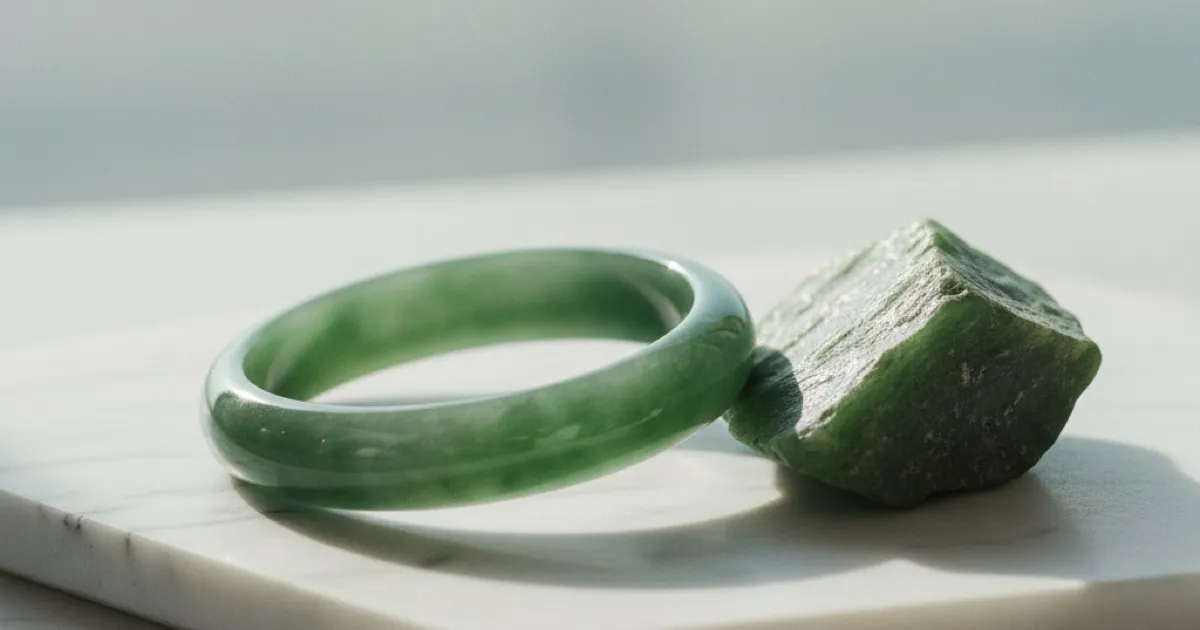
Jade has been prized for thousands of years across Asia, Central America, and New Zealand. A genuine piece of jadeite can sell for tens of thousands of dollars. But the market is flooded with imitations — dyed quartzite, serpentine, glass, and plastic all get passed off as jade.
Whether you inherited a jade bangle, picked one up at an antique shop, or bought a pendant online, you need to know how to tell if jade is real before you assign it any value. These six tests will help you sort genuine jade from fakes using nothing more than your hands, eyes, and a few household items.
Two Types of Real Jade
Before testing, know that "jade" actually refers to two different minerals:
- Jadeite — the rarer, more valuable type. Found mainly in Myanmar (Burma). Colors range from white to deep imperial green. Top-grade jadeite is translucent and intensely green.
- Nephrite — more common and less expensive. Found in China, Canada, Russia, and New Zealand. Usually dark green, gray-green, or white ("mutton fat jade").
Both are real jade. Both pass the tests below. The distinction matters for value — jadeite commands significantly higher prices than nephrite — but for authentication purposes, you're testing whether the stone is either of these minerals versus a fake substitute.
The Temperature Test
Jade is an excellent heat conductor and feels cold to the touch, even at room temperature.
Pick up the piece and hold it against your cheek or the inside of your wrist. Real jade feels noticeably cool, almost like touching a smooth river stone on a cold morning. It stays cool for several seconds before warming to your body temperature.
Plastic and resin fakes feel warm or room temperature immediately. Glass also feels cold initially, but it warms up faster than jade.
Try this: set the piece down for a minute, then pick it up again. Real jade returns to its cool temperature quickly. Plastic stays warm.
This test works well as a first check, but it's not conclusive on its own. Glass and some other stones (like serpentine) also feel cold. Use it alongside the other tests below.
The Sound Test
This is one of the oldest and most reliable methods for identifying jade. Genuine jade produces a distinctive musical sound when struck.
Take two pieces and tap them together gently. Or suspend the piece from a string and tap it with another stone or a coin. Real jade produces a deep, resonant chime that rings for a moment after the tap. The sound is often compared to a bell or wind chime.
Fake jade made from glass produces a higher-pitched, sharper click. Plastic makes a dull thud with no resonance. Dyed quartzite sounds similar to dropping pebbles together — a flat clack without any ring.
If you only have one piece, hang it from a string and tap it with a coin. Listen for that sustained, musical tone. Experienced jade dealers in Chinese and Burmese markets use this test constantly — it's quick and surprisingly accurate.
The Scratch and Hardness Test
Jade is a hard stone. Jadeite rates 6.5-7 on the Mohs hardness scale. Nephrite is slightly softer at 6-6.5. Both are harder than steel, glass, and most common imitation materials.
Try scratching the surface with a steel knife blade or the point of a pair of scissors. Press firmly and drag across an inconspicuous area.
- No scratch — consistent with real jade. The steel blade (hardness 5.5) can't scratch jade.
- Visible scratch mark — the piece is softer than jade and likely an imitation. Serpentine (hardness 2.5-5.5), soapstone (hardness 1-2), and dyed marble (hardness 3) all scratch easily.
You can also try scratching a piece of glass with the jade. Real jade will scratch glass without damaging itself. If the jade gets scratched instead, it's fake.
One warning: this test can leave marks on imitation pieces, so test on an area that won't show. And be aware that some high-end fakes use harder materials that resist scratching.
The Light Test
Hold the piece up to a strong light source — a flashlight or direct sunlight works. Look at how light passes through the stone.
Real jade is translucent to semi-translucent, depending on quality. You should see light filtering through the edges, even if the center is too thick to be transparent. Inside, you'll notice a fibrous, slightly grainy internal structure. Jadeite often shows subtle variations in color depth when backlit.
Fake jade made from glass looks perfectly clear and uniform when lit — no fibrous texture, no variation. Dyed stones may show concentrated color along cracks or veins where the dye settled. If you see color sitting in the fractures rather than evenly distributed through the stone, it's been treated or dyed.
Hold it against your phone flashlight and look closely at the edges. Real jade glows softly. Glass lights up uniformly. Plastic barely lets light through at all.
The Density Test
Jade is dense. Jadeite has a specific gravity of 3.3-3.5. Nephrite is 2.9-3.1. Both are noticeably heavier than most fakes.
Pick up the piece and bounce it lightly in your palm. Genuine jade feels heavier than it looks. If you've handled real jade before, you'll notice the weight difference immediately when holding a fake.
For a more precise test, weigh the piece on a kitchen scale, then measure its volume by water displacement (drop it in a graduated cylinder or measuring cup and note how much the water rises). Divide weight by volume to get the density.
- 2.9-3.5 g/cm³ — consistent with jade
- Below 2.5 g/cm³ — likely serpentine, plastic, or resin
- 2.5-2.7 g/cm³ — could be glass or quartzite
This test is more effort, but it's one of the most reliable ways to distinguish jade from common substitutes.
The Visual Inspection
Examine the piece closely with a magnifying glass or your phone's macro camera. Look for these signs:
Signs of real jade:
- Smooth, waxy luster (not glassy)
- Subtle color variations — genuine jade rarely has perfectly uniform color
- Fine, interlocking fibrous texture visible under magnification
- Cool, soapy feel when rubbed between your fingers
Signs of fake jade:
- Tiny air bubbles inside (indicates glass)
- Perfectly uniform color throughout (natural jade always has some variation)
- Mold lines or seams (indicates molded plastic or resin)
- Color concentrated in cracks (indicates dye treatment)
- Glassy shine rather than waxy luster
Pay special attention to the surface. Real jade has a greasy or waxy shine, not a glassy one. If the piece looks like polished glass, it probably is.
For detailed guidance on identifying all types of gemstones, see our gemstone identification guide.
Common Jade Imitations and How to Spot Them
Knowing what fakes look like helps you test more effectively:
Serpentine (also called "new jade") — softer than jade, scratches easily, lighter weight. Often sold as "Korean jade" or "olive jade." Fails the scratch test.
Dyed quartzite — granular texture under magnification, color sits in cracks. Often sold as "Malaysian jade." Fails the light test.
Glass — too uniform, may have bubbles, warms quickly, sharp click sound. Fails the sound and temperature tests.
Aventurine — a form of quartz with sparkly inclusions. Harder than jade, but the glittery appearance gives it away under magnification.
Chrysoprase — a genuine gemstone sometimes confused with jade. Translucent apple-green. Harder to distinguish, but lacks jade's fibrous texture.
For a broader look at how to separate real stones from imitations, check out our guide on real vs fake jewelry.
What About Treated Jade?
Some jade is genuine but has been chemically treated to improve its appearance. The jade trade classifies pieces by treatment level:
- Type A — natural, untreated jade. Only waxed for polish. This is what collectors want.
- Type B — bleached with acid to remove impurities, then injected with polymer resin. Looks better short-term but degrades over years.
- Type C — dyed to improve color. Often combined with Type B treatment.
Detecting treatment at home is difficult. The light test can reveal dye in cracks (Type C), and treated jade sometimes feels lighter than untreated pieces. But definitive testing for polymer injection (Type B) requires a professional lab with infrared spectroscopy.
If you're buying jade worth more than a few hundred dollars, ask for a certificate from a reputable gemological lab. For quick everyday checks, the home tests above will catch most outright fakes.
How Jewelry Identifier Helps
Running through six tests takes time, and some results need a trained eye to interpret. Jewelry Identifier speeds up the process by letting you photograph your jade piece and get an AI-powered analysis in seconds.
The app identifies the stone type, flags potential fakes, and gives you an estimated value. It reads surface texture, color patterns, and structural details that are hard to evaluate with the naked eye. Bring it to antique shops, estate sales, or use it at home on pieces you already own.
You get 2 free identifications per day. Download Jewelry Identifier on iOS or Android to start checking your jade.
Frequently Asked Questions
Is all green stone jade?
No. Many green stones get misidentified as jade. Serpentine, aventurine, chrysoprase, dyed quartzite, and green glass are all commonly sold as jade but are different materials entirely. Color alone is not enough to identify jade — you need to test hardness, density, sound, and texture.
How much is real jade worth?
It depends on the type and quality. Nephrite jade ranges from $5 to $500 per piece for most jewelry. Fine jadeite can sell for $1,000 to over $100,000 for exceptional pieces. Imperial green jadeite — translucent, vivid green, free of inclusions — is among the most valuable gemstones in the world.
Can jade break if dropped?
Jade is tough but not indestructible. Nephrite is actually one of the toughest natural materials due to its interlocking fiber structure, making it more resistant to breaking than most gemstones. Jadeite is slightly more brittle. Both can chip or crack from a hard impact on a solid surface, but they won't shatter like glass.
Does real jade change color over time?
Untreated jade (Type A) is color-stable and won't change significantly over time. Dyed jade (Type C) can fade or shift color with exposure to heat, sunlight, and skin oils. If your jade piece is noticeably changing color, it was likely treated.
Where does the best jade come from?
Myanmar (Burma) produces the highest-quality jadeite, including imperial green jadeite. Guatemala is another important jadeite source. For nephrite, China has historically been the most significant source, followed by Canada (British Columbia), Russia, and New Zealand. The source affects both quality and market value.