 Jewelry Identifier
How to Tell if an Opal Is Real: 7 Easy Tests
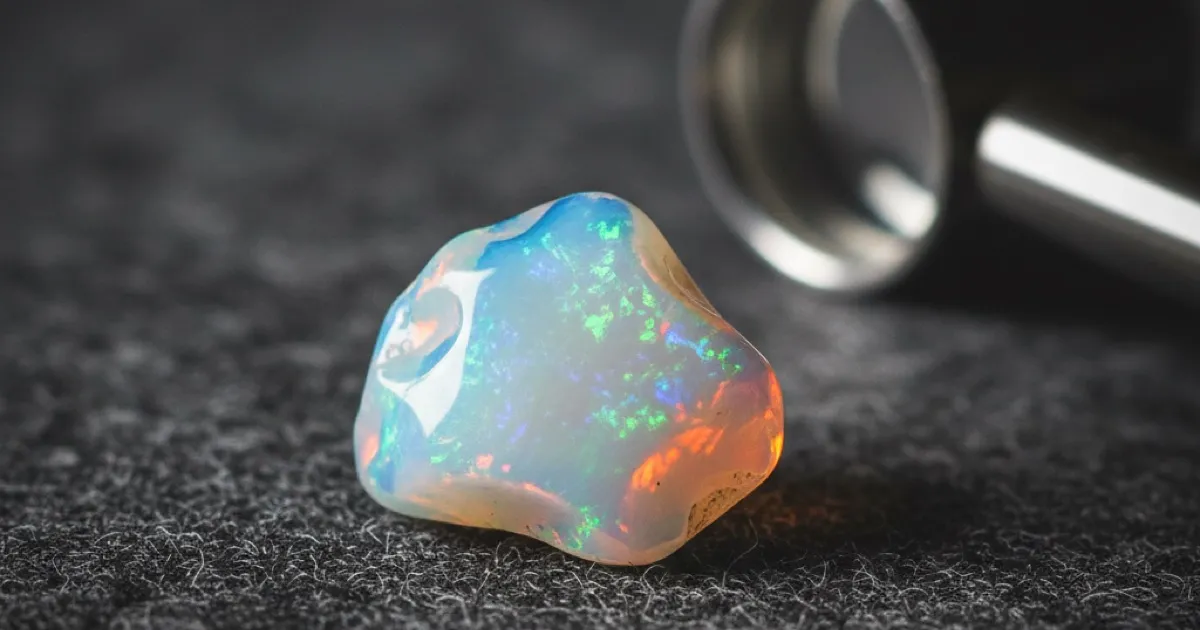
You found an opal at an estate sale. Or maybe you inherited a ring with a milky, rainbow-flashing stone and you're not sure what you're looking at. Opals are one of the most commonly faked gemstones — up there with diamonds, rubies, and sapphires — because their play-of-color effect is easy to imitate with resin, glass, or composite layers. Before you spend money on an appraisal or list it for sale, you can run a few tests at home to figure out whether your opal is genuine.
To tell if an opal is real, examine it for natural play-of-color patterns that shift and change as you rotate the stone. Real opals display irregular, organic color patches, while fakes show uniform or repetitive patterns. Check the back and sides for layered construction — a sign of doublets or triplets — and look for tiny imperfections that natural stones always have.
What Makes Opals Different from Other Gemstones
Opals don't behave like diamonds or sapphires. They're not crystalline. They're made of tiny silica spheres packed together, and the spaces between those spheres diffract light into the colors you see flashing across the surface. That effect is called play-of-color, and it's the single most important thing to evaluate when testing an opal.
Natural opals form over millions of years in underground rock cavities where silica-rich water seeps in and evaporates slowly. The resulting stone contains 3% to 21% water content, which is why opals are softer and more fragile than most gemstones. They score 5.5 to 6.5 on the Mohs hardness scale, compared to 10 for diamonds and 9 for sapphires. This fragility is part of what makes them valuable — genuine opals require careful handling that imitations don't need. Australian mines produce roughly 95% of the world's precious opals, with Lightning Ridge black opals fetching $10,000 or more per carat for top specimens. Ethiopian opals entered the market more recently and tend to cost less, but they're equally genuine. As the October birthstone, opals show up frequently in inherited jewelry collections. Knowing where your opal supposedly came from can help you assess whether the claimed value makes sense for the type.
The Play-of-Color Test
Hold the opal under a bright light and rotate it slowly. Watch how the colors move across the surface.
Signs of a real opal:
- Colors shift and change direction as you tilt the stone
- Patches of color are irregular in size and shape
- You see multiple colors at different angles
- The color appears to come from within the stone, not from the surface
Signs of a fake:
- Colors stay in the same position no matter how you rotate it
- Pattern repeats in a uniform, grid-like way
- Colors look painted on or sit flat on the surface
- Only one or two colors appear, always in the same arrangement
Synthetic opals (lab-created) can also show play-of-color, but the pattern tends to be more regular. Under magnification, synthetic opal color patches often look like a snakeskin or lizard-scale pattern — evenly sized columns arranged in rows. Natural opals have random, organic shapes.
Doublets and Triplets: The Layered Fakes
Not all opal fakes are completely artificial. Doublets and triplets use a thin slice of real opal glued to a backing material, sometimes with a clear dome on top.
Opal doublet: A thin layer of real opal cemented to a dark backing (usually black potch opal, glass, or plastic). From the front, it looks like a solid black opal. From the side, you can see the glue line where the two layers meet.
Opal triplet: Same concept, but with a clear quartz or glass cap on top. Three layers: dome, opal slice, backing. Triplets are the cheapest because the actual opal layer can be paper-thin.
How to spot them:
- Look at the stone from the side. A solid opal has consistent material all the way through. Doublets and triplets show distinct layers
- Check the back. Solid opals have a natural, uneven back. Doublets have a flat, dark, uniform backing
- If the stone is set in jewelry, a bezel setting that hides the sides might be covering a doublet construction
- Hold it up to light from behind. A solid opal transmits some light through the body. Doublets block light at the backing layer
Doublets and triplets aren't worthless — they contain real opal — but they're worth a fraction of solid stones. A solid white opal might sell for $50 to $200 per carat, while a comparable doublet sells for $10 to $30.
The Water Test
Genuine opals absorb small amounts of water because of their porous silica structure. Soak the stone in water for a few hours and watch what happens.
- A real opal may become slightly more transparent as it absorbs water. Some Ethiopian opals turn nearly clear, which is called hydrophane behavior
- Plastic or resin imitations won't absorb any water and will look exactly the same
- Glass fakes also show zero change
One warning: this test works best on loose stones. Don't soak opal jewelry because water can weaken the glue in doublets and triplets, and it may damage metal settings.
The Temperature Test
Opals warm up slowly in your hand because they're poor heat conductors. Glass and resin reach body temperature faster.
Pick up the stone and hold it against your cheek or the inside of your wrist. A real opal feels cool for several seconds before warming up. Glass imitations warm up almost immediately. This test isn't definitive on its own, but combined with other tests, it helps build the picture.
Check Under Magnification
If you have a 10x jeweler's loupe or even a phone camera with macro mode, examine the surface closely.
Real opal characteristics:
- Tiny imperfections, pits, or inclusions in the body
- Color patches with soft, blurred edges
- An uneven surface texture at high magnification
- Possible crazing (fine surface cracks) in older or poorly stored opals
Fake opal characteristics:
- Perfectly smooth, bubble-free surface (resin or glass)
- Sharp, geometric edges on color patches (synthetic)
- Air bubbles trapped inside (glass or resin)
- A visible seam or glue line along the edges (doublet/triplet)
Black Light (UV) Test
Under ultraviolet light, many natural opals show a faint white or blue-green fluorescence. Synthetic opals often glow brighter and more uniformly. Some natural opals don't fluoresce at all, so a negative result doesn't prove it's fake — but a very strong, even glow across the entire stone suggests it's synthetic or treated.
You can buy a small UV flashlight for under $15. Test in a dark room for the best results.
How Jewelry Identifier Helps with Opal Testing
Identifying opals gets tricky when you're comparing play-of-color patterns or trying to decide if a stone is a solid versus a doublet. Jewelry Identifier can speed up the process. Snap a photo of the stone, and the app identifies the gemstone type, reads any stamps on the setting, and gives you an estimated appraisal value. It works for both loose stones and pieces already set in jewelry.
If you're sorting through inherited pieces or shopping at an estate sale without internet access, the offline database lets you look up gemstone characteristics on the spot. The app gives you a starting point — you'll know whether you're likely holding a genuine opal or something else before deciding whether a professional appraisal is worth the cost.
Frequently Asked Questions
Is a doublet or triplet opal considered fake?
Not exactly. Doublets and triplets contain real opal, but the stone isn't solid. They're assembled pieces — a thin slice of genuine opal glued to a backing, sometimes with a glass cap. They're legitimate products when sold honestly, but they're worth far less than solid opals. A doublet typically sells for 10% to 20% of what a comparable solid opal costs.
Can synthetic opals pass all these tests?
Lab-created opals can pass the temperature and water tests because they have similar chemical composition to natural opals. The best way to distinguish them is under magnification — synthetic opals show a characteristic columnar or snakeskin-like pattern in their play-of-color that natural opals lack. A jeweler with a loupe can usually spot this pattern.
Do all real opals show play-of-color?
No. Common opal (also called potch) is real opal that doesn't display play-of-color. It can be white, gray, or brown and looks fairly ordinary. Only precious opal shows the rainbow effect. Potch is genuine opal but has little gemstone value compared to precious opal specimens.
Why do some opals turn clear in water?
Ethiopian opals are hydrophane, meaning they absorb water and become transparent. This is normal and doesn't mean the stone is fake. The opal returns to its original appearance once it dries out, usually within a few hours to a day. Australian opals don't typically show this behavior.
How much is a real opal worth?
Values range wildly depending on type, size, and quality. Common white opals sell for $10 to $80 per carat. Good Australian crystal opals go for $100 to $500 per carat. Top-grade Lightning Ridge black opals can exceed $10,000 per carat. Ethiopian opals typically run $20 to $200 per carat for quality specimens.
Try Jewelry Identifier to check whether your opal is genuine — take a photo and get an instant identification and estimated value.