 Jewelry Identifier
How to Tell if an Emerald Is Real: 5 Tests You Can Do at Home
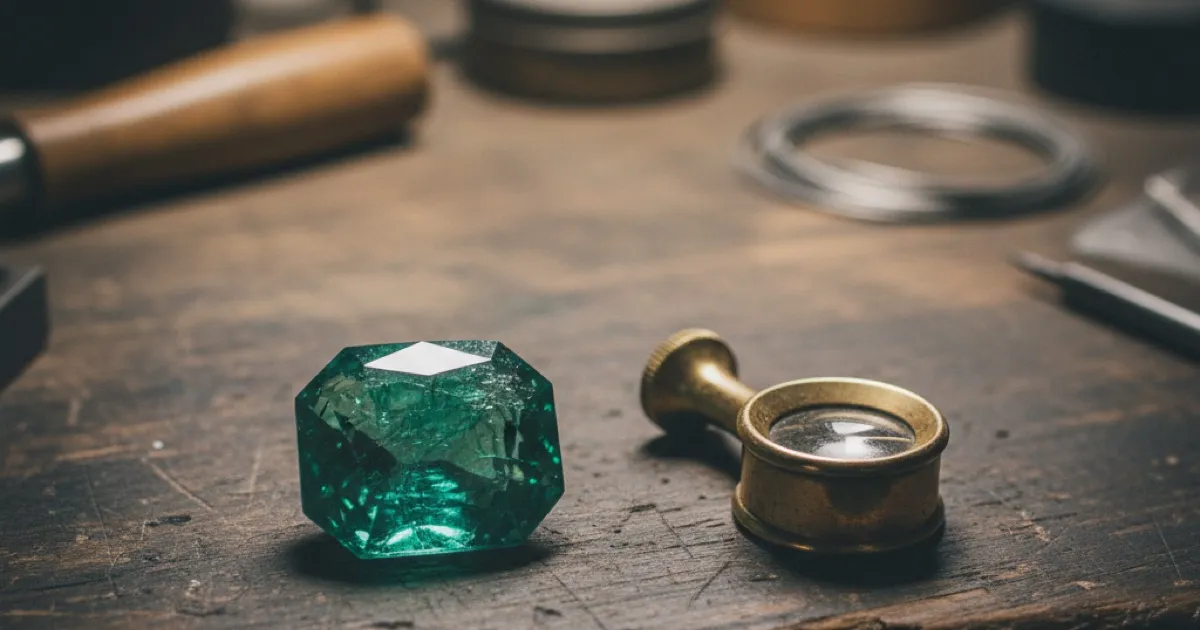
Emeralds are one of the most valuable gemstones in the world and one of the most frequently faked. Genuine emeralds of good quality sell for $500 to $5,000 per carat, and exceptional Colombian stones reach $50,000 or more. With prices like that, glass, synthetic emeralds, and dyed beryl flood the market at every level.
If you have an emerald ring from a relative, picked one up at an estate sale, or bought one online that seems too good to be true, these five tests will help you figure out how to tell if an emerald is real before spending money on a professional appraisal.
Real emeralds almost always contain visible inclusions called "jardin" (French for garden) — tiny fractures, mineral crystals, and gas bubbles that formed during millions of years of growth underground. A perfectly clean emerald with no visible flaws is either synthetic, simulant, or worth a small fortune. This single observation rules out more fakes than any other test.
Test 1: Check for Inclusions (The Jardin Test)
This is the most important test. Pick up a 10x jeweler's loupe or use your phone camera's zoom, and look closely into the stone.
Natural emeralds are famous for their inclusions. Unlike diamonds where flawless is the goal, emerald dealers expect and accept inclusions because they confirm natural origin. The gemstone trade calls these inclusions "jardin" because the patterns of tiny fractures, trapped crystals, and growth features resemble a miniature garden viewed from above.
What natural emerald inclusions look like varies by origin, but the key diagnostic features share common traits across all sources. Colombian emeralds typically contain three-phase inclusions — tiny cavities holding a liquid, a gas bubble, and a salt crystal simultaneously. These are nearly impossible to replicate in synthetic production and serve as strong evidence of natural origin. Zambian emeralds tend toward darker inclusions with iron-bearing minerals like actinolite needles and black mica flakes. Brazilian emeralds often show biotite crystals and liquid-filled tubes running parallel to the crystal's growth direction. Regardless of origin, the presence of natural mineral inclusions with irregular shapes and random distribution points to a genuine stone. Synthetic emeralds grown by flux methods contain characteristic wispy, veil-like inclusions that look different from natural jardin — they're more uniform and feathery. Hydrothermal synthetics may show chevron-shaped growth patterns. Glass imitations contain round air bubbles, which are a dead giveaway. If you see spherical bubbles under magnification, the stone is glass.
What to look for:
- Natural emerald: Jardin (garden-like inclusions), three-phase inclusions, mineral crystals, irregular fractures
- Synthetic (flux): Wispy veils, feathery patterns, unusually uniform inclusions
- Synthetic (hydrothermal): Chevron growth patterns, seed plate remnants
- Glass or composite: Round air bubbles, flow lines, flat layer boundaries
Test 2: The Sparkle Test
Hold the emerald under a bright light and watch how it handles light.
Real emeralds do not produce "fire" — the rainbow flashes you see in diamonds. Emeralds have a vitreous (glass-like) luster with a warm, deep glow rather than sharp sparkle. The light that enters an emerald gets absorbed selectively, letting green wavelengths through while dampening others. This creates that characteristic rich green color but not much spectral dispersion.
If your stone throws vivid rainbow flashes from multiple angles, it's likely not an emerald. It could be green cubic zirconia, green glass, or a green garnet (tsavorite garnet has more fire than emerald).
One exception: very high-quality emeralds with excellent clarity and cut can show some brilliance, but it's a soft, warm shimmer — not the sharp prismatic fire of a diamond or CZ.
Test 3: The Color Test
Emerald color tells you a lot about authenticity and origin.
Natural emeralds display a range of green tones, from slightly bluish-green to slightly yellowish-green, with the most valued being a medium-to-dark bluish-green. Hold the stone under different light sources — daylight, incandescent, and fluorescent. A real emerald maintains its green character across lighting conditions, though the warmth or coolness of the green may shift slightly.
Red flags to watch for:
- Too vivid or electric green: Natural emeralds have depth and complexity to their color. If the green looks flat, overly bright, or neon-like, it may be dyed or synthetic
- Perfectly uniform color: Natural emeralds show color zoning — areas where the green is slightly darker, lighter, or shifts in tone. Hold the stone at different angles. Perfectly even color from every direction suggests synthetic or glass
- Yellow-green with no blue: While some natural emeralds lean yellowish, a strong yellow-green with zero blue component may be green beryl (a related but less valuable stone) rather than true emerald
- Turns a different color: If the stone looks green in one light but shifts to brown or gray in another, it may be a different gemstone entirely
Test 4: The Blacklight (UV) Test
A UV flashlight costs about $10 and provides useful data for emerald testing.
Hold the stone under a long-wave UV light in a dark room. Natural emeralds typically show weak to no fluorescence — most will appear inert (dark) or show a very faint dull red. This is because emeralds absorb UV radiation rather than re-emitting it.
Synthetic emeralds often fluoresce differently. Flux-grown synthetics may show a stronger red fluorescence than natural stones. Some synthetic emeralds display a distinctive bright red glow that natural stones of the same color almost never produce.
Glass imitations vary widely under UV, but many show a greenish or yellowish glow that differs from the expected emerald response.
This test is not definitive on its own — some natural emeralds from certain deposits do fluoresce. But a very strong, bright fluorescence is worth investigating further.
Test 5: The Weight and Temperature Test
This requires no tools beyond your hands.
Real emeralds have a specific gravity of 2.67-2.78 — they feel heavy for their size compared to glass (which has a similar specific gravity of about 2.5 but can vary) and much lighter than cubic zirconia (5.6-6.0). If you have a known glass stone of similar size to compare, the emerald should feel slightly heavier.
Temperature is also informative. Genuine emeralds feel cool to the touch initially and warm up slowly in your hand. Glass and plastic imitations reach skin temperature faster. This test works best when the stone has been sitting at room temperature, not after being worn.
Oil Treatment: What You Should Know
Most natural emeralds on the market have been oil-treated. This is standard industry practice, not fraud.
Because emeralds naturally contain fractures that reach the surface, treaters apply cedar oil or synthetic resin to fill these fractures and improve the stone's appearance. An estimated 90-95% of emeralds in jewelry have been treated this way.
Oil treatment is permanent under normal wear conditions but can be damaged by ultrasonic cleaning, harsh chemicals, or extreme heat. If you're cleaning an emerald, never use an ultrasonic cleaner or steam — stick to a damp cloth. For more on safe cleaning methods by stone type, see our jewelry cleaning guide.
An oiled emerald is still a real emerald. Untreated emeralds of fine quality are rare and command significant premiums — often 2-10x the price of treated stones of similar appearance.
How Jewelry Identifier Helps with Emerald Verification
Testing emeralds at home gives you a good starting point, but AI identification adds another layer of confidence.
Snap a photo of your emerald piece with Jewelry Identifier, and the app identifies the gemstone type, reads stamps and hallmarks on the setting, and gives you an estimated appraisal value. It can help distinguish emeralds from common look-alikes like green glass, dyed quartz, and chrome diopside based on visual characteristics.
The app also identifies the setting metal — knowing whether your emerald is set in platinum, 18K gold, or silver helps estimate total piece value. Two free identifications per day let you check pieces before deciding if a professional gemologist visit is worthwhile. The offline gemstone identification database means you can reference emerald characteristics even without internet access.
The app provides AI estimates, not certified appraisals. For emeralds that appear to be high quality (vivid color, good clarity, over 1 carat), confirm with a certified gemologist. Natural emeralds with documented origin (Colombian, Zambian) and minimal treatment carry substantial premiums that require expert verification. See our guide on how to determine jewelry value for more on valuation factors.
Frequently Asked Questions
Are lab-created emeralds considered real?
Lab-created emeralds are chemically identical to natural ones — both are beryl colored by chromium and vanadium. They are "real" emeralds in terms of composition, but they're not "natural." Lab emeralds cost 80-95% less than natural stones of similar appearance. Jewelers are required to disclose synthetic origin at point of sale.
Can you scratch an emerald?
Emeralds rate 7.5-8 on the Mohs hardness scale, making them harder than most household materials. However, emeralds are more brittle than their hardness suggests because of their internal fractures. A sharp impact can chip or crack an emerald even though it resists scratching. Handle emerald jewelry with more care than you would a sapphire or diamond.
What's the difference between an emerald and green beryl?
Both are the mineral beryl, but emerald must meet a minimum color saturation threshold to earn the name. Pale or light green beryl doesn't qualify as emerald — it's simply "green beryl" and is worth considerably less. The exact threshold varies between gemological labs, which is why some stones are classified as emerald by one lab and green beryl by another.
How can I tell a real emerald from green glass?
Check for inclusions first — natural emeralds have garden-like internal features while glass contains round air bubbles. Emeralds feel cooler to the touch. Under magnification, emeralds show natural fracture patterns while glass shows flow lines. Emeralds also scratch glass (Mohs 7.5-8 vs glass at 5.5).
Wondering if your emerald is genuine? Try Jewelry Identifier to snap a photo and get an instant gemstone identification and estimated value — two free scans daily, no subscription needed.