 Jewelry Identifier
How to Tell if a Sapphire Is Real: At-Home Tests That Work
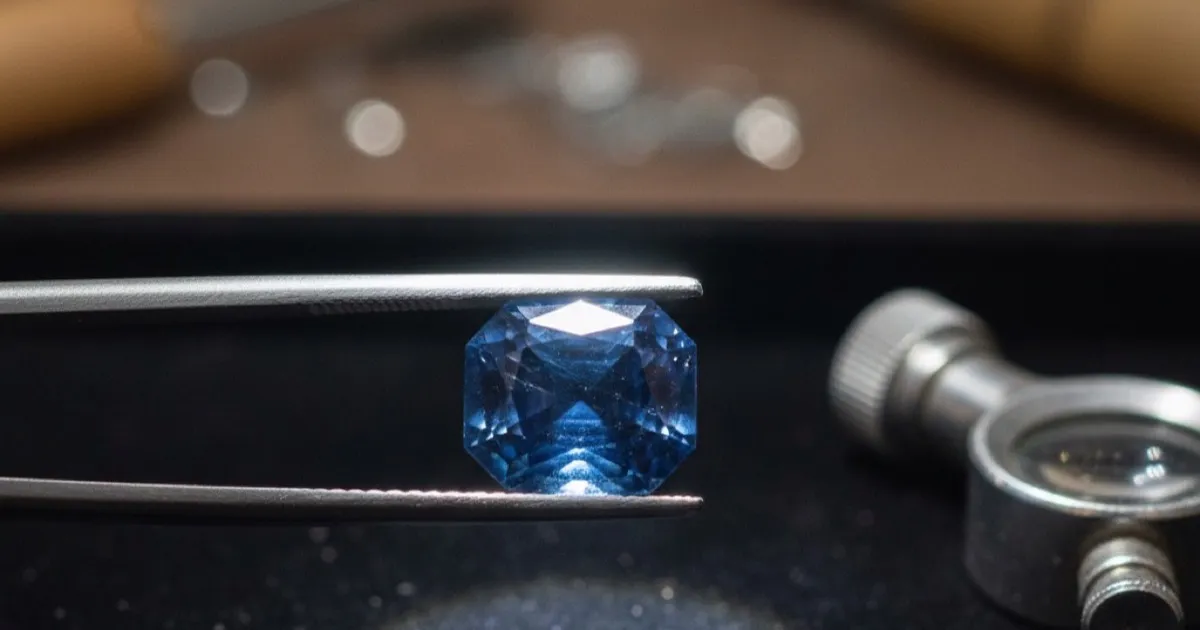
Sapphires are the second hardest natural gemstone after diamonds, and that makes them one of the most faked. Glass, synthetic corundum, and dyed stones flood the market at every price point. Whether you inherited a sapphire ring, found one at an estate sale, or just want to verify what you bought, knowing how to tell if a sapphire is real saves you from overpaying or undervaluing what you have.
This guide covers the at-home tests that actually work, what to look for under magnification, and when you need professional verification. For a broader overview of testing any gemstone, see our gemstone identification guide.
A real sapphire can be identified through a combination of hardness testing, inclusion inspection, and light behavior analysis. Natural sapphires rate 9 on the Mohs scale, contain characteristic needle-like rutile inclusions called "silk," and display a consistent body color without the rainbow fire seen in diamonds or glass. Synthetic sapphires pass most visual checks but lack the natural inclusion patterns found in mined stones.
The Fog Test
This is the fastest screening test you can do with no tools at all.
Hold the sapphire close to your mouth and breathe on it, the same way you'd fog up a window. A real sapphire disperses heat almost instantly because of its high thermal conductivity. The fog should disappear within 1-2 seconds.
Glass and cubic zirconia hold moisture longer — usually 4-5 seconds. If the fog lingers, that's a red flag, though not conclusive on its own. Temperature, humidity, and the size of the stone all affect how quickly fog clears.
This test rules out obvious glass fakes but won't catch synthetic sapphires, which have the same thermal properties as natural ones.
The Scratch Test
Sapphires rank 9 on the Mohs hardness scale — only diamonds are harder. (Sapphire is September's birthstone, making it one of the most gifted and inherited gemstones.) This means a real sapphire should scratch glass, steel, and most other gemstones without taking any damage itself.
Try scratching an inconspicuous area of a glass surface with a corner of the stone. If the stone leaves a scratch on the glass, it's at least as hard as a sapphire. If the stone shows a scratch mark instead, it's softer than sapphire and likely glass or a lower-hardness simulant.
A few caveats: synthetic sapphires are also 9 on Mohs, so this test confirms hardness but not natural origin. And only do this test on a stone you own — never on someone else's jewelry.
Inspecting Inclusions Under Magnification
This is the most reliable at-home test for separating natural sapphires from synthetics and fakes.
Natural sapphires contain characteristic inclusions visible under 10x magnification with a jeweler's loupe. The specific types of inclusions tell you whether the stone formed in the earth over millions of years or was grown in a lab over weeks. Look for these natural indicators: "silk" — fine, needle-like rutile crystals that intersect at 60-degree angles, following the hexagonal crystal structure of corundum. These delicate needles scatter light and create the velvety appearance prized in Kashmir sapphires. You might also see tiny crystal inclusions (other minerals trapped during formation), fingerprint-like healed fractures, and color zoning — visible bands where color intensity shifts across the stone. Synthetic sapphires grown by flame fusion show curved growth lines (called striae) rather than the straight, angular zoning of natural stones. Lab-grown sapphires from flux or hydrothermal methods can contain flux remnants that look like wispy veils or fingerprints, but they lack the characteristic rutile silk. Glass imitations show round air bubbles — a dead giveaway. If you see even one spherical bubble, the stone is glass, not sapphire.
What you're looking for:
- Natural sapphire: Rutile silk (fine needles), crystal inclusions, straight color zoning, fingerprint-like healed fractures
- Synthetic (flame fusion): Curved growth lines, gas bubbles, perfectly uniform color
- Synthetic (flux/hydrothermal): Flux veils, no rutile silk, unusually clean
- Glass: Round air bubbles, swirl marks, lower luster
The Light Test
Hold the sapphire up to a bright light source and observe how it handles light.
A real sapphire shows a single body color — blue sapphires appear blue from every angle, though the intensity may vary slightly due to pleochroism (sapphires show two colors, typically blue and violet-blue, depending on viewing angle). The color should look rich and slightly uneven, not perfectly uniform.
If the stone throws rainbow flashes like a diamond, it's probably not a sapphire. Sapphires produce a muted, silky brilliance rather than spectral fire. Glass imitations often show too much brilliance and may display a different color when light passes through at certain angles.
Check the stone against a white background too. Natural sapphires often show subtle color zoning — areas where the blue is darker or lighter. Perfectly uniform color from every angle suggests either a synthetic stone or glass.
The Water Test
Drop the sapphire into a glass of water. This test checks density, not authenticity directly.
Natural and synthetic sapphires have a specific gravity around 3.95-4.03 — they sink quickly and feel heavy for their size. Glass imitations are lighter (specific gravity around 2.2-2.5) and sink more slowly. Cubic zirconia is actually heavier than sapphire (5.6-6.0), so it sinks even faster.
This test is useful for ruling out glass but won't distinguish natural from synthetic sapphire.
Color and Clarity Red Flags
Certain visual characteristics should make you suspicious:
- Too perfect: A sapphire with no visible inclusions, perfectly uniform color, and flawless clarity is almost certainly synthetic or simulated. Natural sapphires of that quality exist but cost tens of thousands of dollars per carat
- Wrong blue: Natural sapphires range from pale cornflower blue to deep navy. If the stone is a bright, electric blue with no depth or variation, it may be dyed or synthetic
- Color change in different lighting: Some natural sapphires do show slight color shifts between daylight and incandescent light. But dramatic color changes (blue to purple) at different angles suggest a different stone entirely, possibly alexandrite or color-change garnet
- Star effect when there shouldn't be one: Star sapphires show a six-rayed star (asterism) under direct light. If a non-star sapphire shows any star pattern, examine it closely — some fakes use a coating to simulate this effect
What About Star Sapphires?
Star sapphires deserve special mention because they're both valuable and frequently faked.
The star effect (asterism) in a genuine star sapphire comes from aligned rutile needle inclusions within the stone. The star should move smoothly across the surface as you tilt the stone under a single light source. Each ray should be straight and sharp.
Fake star sapphires use a diffusion treatment or coating to create the star on the surface rather than from within the stone. Under magnification, you can sometimes see the star pattern sitting on top of the stone rather than emerging from within it.
Genuine star sapphires typically have a slightly milky or translucent body — a perfectly transparent star sapphire is extremely rare and valuable. If the stone is crystal clear with a sharp star, verify it carefully.
How Jewelry Identifier Helps with Sapphire Authentication
Running through all these tests takes time, and some require tools most people don't have at home. Jewelry Identifier gives you a quick first assessment.
Take a photo of your sapphire piece, and the app identifies the gemstone type, reads any hallmarks or stamps on the setting, and provides an estimated appraisal value. It can distinguish sapphires from common simulants like blue glass, blue topaz, and tanzanite based on visual characteristics. The app also identifies the setting metal, so you'll know if that sapphire ring is mounted in platinum, white gold, or silver.
Two free identifications per day let you screen pieces before investing in a professional appraisal. The offline gemstone database includes detailed reference information for comparing what you see under magnification against known sapphire characteristics.
The app provides AI-based estimates, not GIA-certified grading. For sapphires you suspect are high-value (deep color, good clarity, over 2 carats), follow up with a certified gemologist who can confirm natural origin and provide documentation for insurance or resale.
Frequently Asked Questions
Can synthetic sapphires pass a diamond tester?
Diamond testers measure thermal conductivity, and sapphires (both natural and synthetic) have different thermal properties than diamonds. A standard diamond tester will correctly identify a sapphire as "not diamond," but it won't tell you whether the sapphire is natural or lab-created. For that distinction, you need inclusion analysis under magnification.
How can I tell a sapphire from blue topaz?
Blue topaz is lighter in color, has a different crystal structure, and rates 8 on Mohs (compared to sapphire's 9). Under magnification, topaz shows different inclusion patterns. The easiest tell: blue topaz has a watery, transparent quality while sapphires have a denser, more saturated appearance. Topaz also weighs less — it has a specific gravity of 3.49-3.57 versus sapphire's 3.95-4.03.
Are heat-treated sapphires still real?
Yes. Heat treatment is standard practice in the sapphire industry — roughly 90-95% of sapphires on the market have been heat-treated to improve color and clarity. Heat-treated sapphires are still natural stones. The treatment is permanent and universally accepted. Untreated sapphires of fine quality command a premium, sometimes 2-5x the price of treated equivalents.
What's the most valuable sapphire color?
Kashmir sapphires — a velvety, medium-to-deep blue with a slight violet hue — are considered the most valuable. "Royal blue" sapphires from Myanmar and Sri Lanka also command high prices. Padparadscha sapphires (pink-orange) from Sri Lanka are the rarest colored sapphire variety and can exceed $30,000 per carat for fine specimens.
Do real sapphires glow under UV light?
Most natural blue sapphires show weak to no fluorescence under UV light. Some sapphires from certain origins (like Sri Lanka) show a faint orange-red glow under long-wave UV. Strong blue or green fluorescence under UV suggests synthetic origin. However, UV testing alone isn't definitive — use it alongside other tests.
Not sure if your sapphire is genuine? Try Jewelry Identifier to snap a photo and get an instant gemstone identification and estimated value — two free scans daily, no subscription needed.